
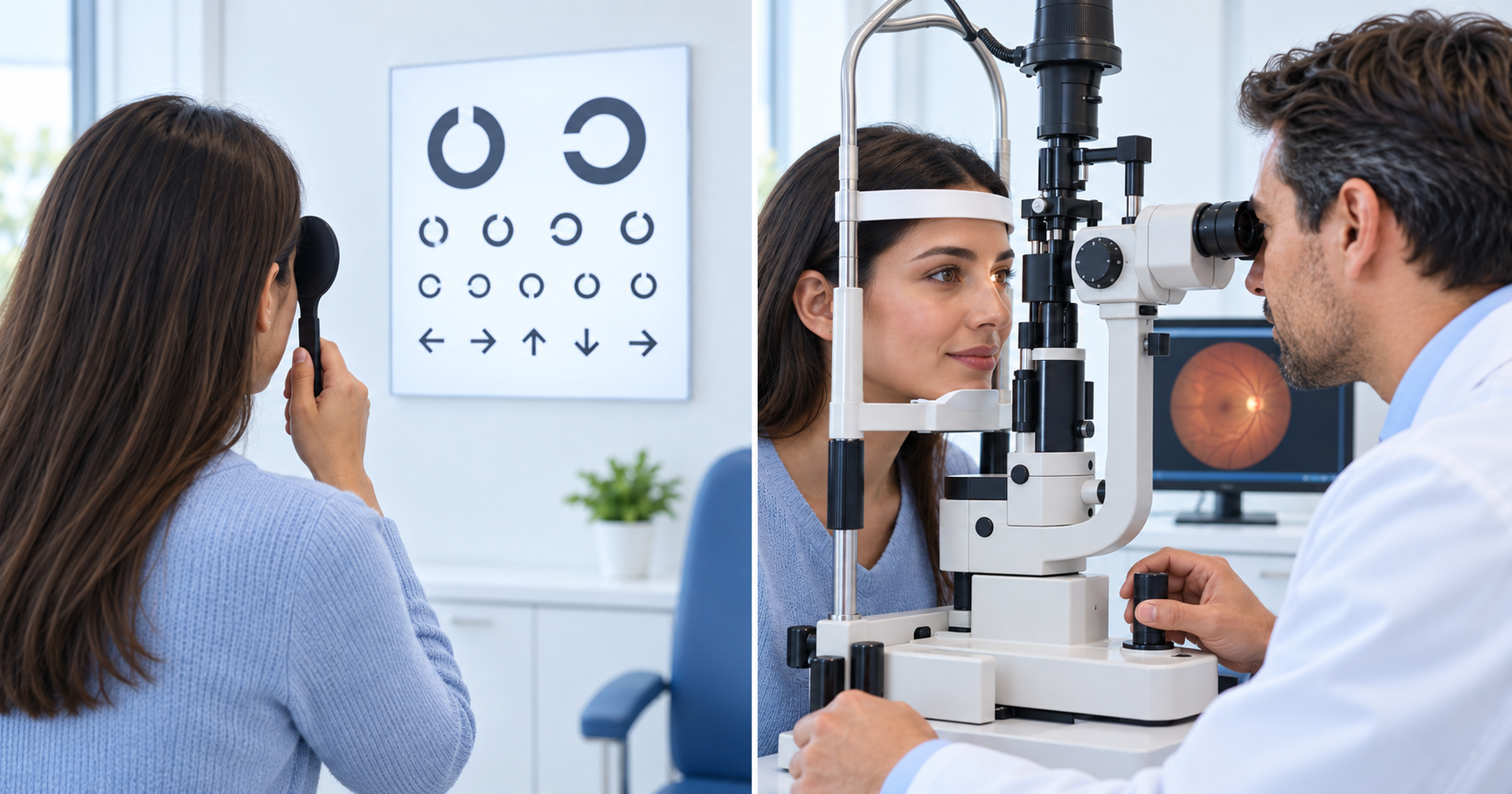
Many people use the terms eye exam and vision test interchangeably, but they are not necessarily the same thing. A vision test generally focuses on how clearly you can see, while a comprehensive eye exam goes further by assessing both your vision and the overall health of your eyes.
Understanding the difference is important because being able to read an eye chart clearly does not always mean your eyes are healthy. Some eye conditions can develop without obvious symptoms, which is why regular eye examinations are an important part of maintaining your eye health.
If you are wondering whether you need a simple vision test or a comprehensive eye exam, here is what you should know.
What Is a Vision Test?
A vision test is generally a basic assessment of how clearly you can see.
One of the most familiar examples is reading letters or symbols from an eye chart. The test may be performed to determine whether you can see clearly at a particular distance.
A vision test may help identify common refractive errors, such as:
- Nearsightedness (myopia)
- Farsightedness (hyperopia)
- Astigmatism
- Changes in your existing prescription
Depending on where the test is performed, it may also involve checking near vision or asking you to identify colours or other visual information.
A vision test can be useful for identifying whether your eyesight appears to need correction, but it does not necessarily provide a complete assessment of your eye health.
What Is a Comprehensive Eye Exam?
A comprehensive eye exam is a more detailed assessment performed by an optometrist.
It looks at more than how clearly you can see. Your optometrist assesses your vision and examines the health of different structures of your eyes.
Depending on your age, symptoms, health history, family history, and risk factors, a comprehensive eye exam may include:
- Visual acuity testing.
- Refraction to determine your prescription.
- Assessment of eye movement and coordination.
- Evaluation of focusing ability.
- Pupil assessment.
- Eye pressure measurement.
- Examination of the front of the eyes.
- Examination of the retina and optic nerve.
- Additional imaging or testing when appropriate.
The exact tests performed can vary from one person to another.
Eye Exam vs. Vision Test: What’s the Difference?
The easiest way to understand the difference is to consider the purpose of each.
Vision Test | Comprehensive Eye Exam |
Primarily checks how clearly you see | Checks vision and eye health |
May identify the need for vision correction | Assesses prescription and eye health |
Usually focuses on visual acuity | Includes multiple assessments |
May be relatively brief | Can involve several different tests |
Does not necessarily provide a complete eye health assessment | Can help identify signs of eye conditions |
May be used as a basic screening | Performed by an optometrist as a more complete assessment |
A vision test can tell you whether you are seeing clearly at a particular distance. A comprehensive eye exam provides a much broader picture of how your eyes are functioning and whether there are signs of potential eye health concerns.
Does 20/20 Vision Mean Your Eyes Are Healthy?
Not necessarily.
Having 20/20 vision generally means that you can see at a certain level of clarity at a specified distance. It does not mean that every part of your eyes is healthy.
For example, some eye diseases can develop without affecting your central vision in the early stages.
An eye exam allows an optometrist to look beyond visual sharpness and assess structures such as the retina and optic nerve. This can be particularly important for people who have risk factors for eye disease.
In other words, good vision and good eye health are related, but they are not exactly the same thing.
What Does an Eye Exam Check That a Vision Test May Not?
A comprehensive eye examination can provide information about several aspects of your eye health that a basic vision test may not assess.
Eye Pressure
Your optometrist may measure the pressure inside your eyes as part of assessing your risk for glaucoma.
Glaucoma can damage the optic nerve and may progress without noticeable symptoms in its early stages.
Retina
The retina is the light-sensitive tissue at the back of the eye.
An optometrist can examine the retina for signs of abnormalities or conditions that may require monitoring or further assessment.
Optic Nerve
The optic nerve carries visual information from the eye to the brain.
Examining the optic nerve can provide important information about eye health and may help identify signs associated with conditions such as glaucoma.
Eye Structures
A comprehensive exam may also involve examining the cornea, lens, iris, and other structures at the front of the eye.
These assessments can help identify changes that may not be apparent from a basic vision test.
Can an Eye Exam Detect Health Problems?
An eye examination primarily evaluates your vision and eye health, but certain changes observed in the eyes can also be associated with broader health conditions.
For example, changes in the blood vessels of the retina can sometimes provide information relevant to conditions such as diabetes or high blood pressure.
People with diabetes are at increased risk of diabetic eye disease, which can affect the retina. Importantly, diabetic eye disease may not cause noticeable vision changes during its early stages.
This is one reason people with diabetes may require regular eye examinations and retinal monitoring.
An eye exam does not replace your regular medical care, but findings during an examination may indicate that additional medical assessment is appropriate.
Also Read: How Do You Know If You Need Glasses?
Who Should Have a Comprehensive Eye Exam?
A comprehensive eye exam can be beneficial for people of all ages.
Children
Regular eye examinations are important during childhood because vision plays an important role in learning and development.
Children may not always realize or communicate that they have difficulty seeing. An eye examination can help identify vision problems that could affect schoolwork, reading, sports, or other activities.
Adults
Adults should continue to have their eyes examined even if they do not wear glasses or contact lenses.
Vision can change gradually, and some eye conditions may not cause obvious symptoms.
Adults Over 40
Age-related changes in vision become more common as people get older.
Presbyopia, for example, can make it more difficult to focus on nearby objects. Other eye conditions also become more common with age.
Regular eye examinations allow your optometrist to monitor these changes.
Older Adults
Older adults may have an increased risk of conditions such as cataracts, glaucoma, and age-related retinal changes.
Your optometrist can recommend an examination schedule based on your age, eye health, and individual risk factors.
Do You Need an Eye Exam If You Don’t Wear Glasses?
Yes.
Not wearing glasses or contact lenses does not mean that you do not need regular eye examinations.
An eye exam is not only about determining whether you need vision correction. It also evaluates the health of your eyes.
Someone can have clear vision and still develop an eye condition that requires monitoring or treatment.
This is why it is important not to wait until you need glasses before having your eyes examined.
How Often Should You Have an Eye Exam?
The recommended frequency depends on several factors, including your age, eye health, medical history, family history, and risk factors.
Children generally need regular examinations as their vision develops. Healthy adults may require eye exams every few years, while older adults or people with certain medical conditions may need more frequent monitoring.
If you already have an eye condition, wear corrective lenses, have diabetes, have a family history of certain eye diseases, or have noticed changes in your vision, your optometrist may recommend a different schedule.
If you are unsure when you should have your next eye exam, an optometrist can recommend a schedule based on your individual needs.
When Should You Have an Eye Exam Sooner?
You should not always wait for your next routine appointment if you notice a change in your vision.
Consider scheduling an eye examination if you experience:
- New or persistent blurry vision.
- Frequent headaches or eye strain.
- Difficulty seeing at night.
- Increased sensitivity to light.
- Difficulty focusing.
- Double vision.
- Persistent dry or irritated eyes.
- A sudden increase in floaters.
- Flashes of light.
- Changes in your peripheral vision.
Sudden vision loss, a curtain-like shadow over your vision, sudden flashes and many new floaters, significant eye pain, or a serious eye injury can require urgent assessment.
Is a Vision Test Enough for a New Glasses Prescription?
A basic vision screening may indicate that your vision needs correction, but a comprehensive eye examination provides a more complete assessment.
If you are experiencing changes in your vision or need a new glasses prescription, an optometrist can perform the appropriate tests to determine your prescription while also checking your eye health.
This is particularly useful if you have not had an eye examination for several years.
What Should You Expect During a Comprehensive Eye Exam?
A comprehensive eye exam usually begins with questions about your vision and health history.
Your optometrist may then perform several tests to assess your vision and eye health. These can include visual acuity testing, refraction, eye movement assessment, eye pressure measurement, and examination of the front and back of the eyes.
The specific tests you receive depend on your individual needs.
After the examination, your optometrist will discuss the results with you and explain whether you need a new prescription, additional monitoring, treatment, or further assessment.
Choose Smart Opticals for Your Eye Care
A vision test can tell you how clearly you see, but a comprehensive eye exam provides a much broader assessment of your vision and eye health.
Even if your eyesight seems fine, regular eye examinations can help monitor changes and identify potential concerns before they begin affecting your everyday vision.
At Smart Opticals, our team provides comprehensive eye examinations to help patients maintain healthy vision and understand their individual eye care needs. Whether you need to update your prescription, have noticed changes in your vision, or are due for a routine examination, our eye care team can assess your vision and overall eye health.
Contact Smart Opticals to schedule your comprehensive eye exam.
Frequently Asked Questions
Is an eye exam the same as a vision test?
No. A vision test generally focuses on how clearly you can see, while a comprehensive eye exam evaluates both your vision and the health of your eyes.
Can you have 20/20 vision and still need an eye exam?
Yes. 20/20 vision describes visual sharpness at a particular distance. It does not guarantee that your eyes are free from disease or other problems.
Does an eye exam check for glaucoma?
A comprehensive eye exam may include assessments that help evaluate your risk for glaucoma, such as measuring eye pressure and examining the optic nerve. Your optometrist may recommend additional testing when appropriate.
Do people without glasses need eye exams?
Yes. Eye examinations are important even for people who do not need glasses because they also assess overall eye health.
How often should I have a comprehensive eye exam?
The appropriate schedule depends on your age, eye health, medical history, family history, and other risk factors. Your optometrist can recommend an examination schedule that is appropriate for you.
What is better, a vision test or an eye exam?
They serve different purposes, but a comprehensive eye exam provides a more complete assessment because it evaluates both vision and eye health rather than focusing only on visual clarity.