
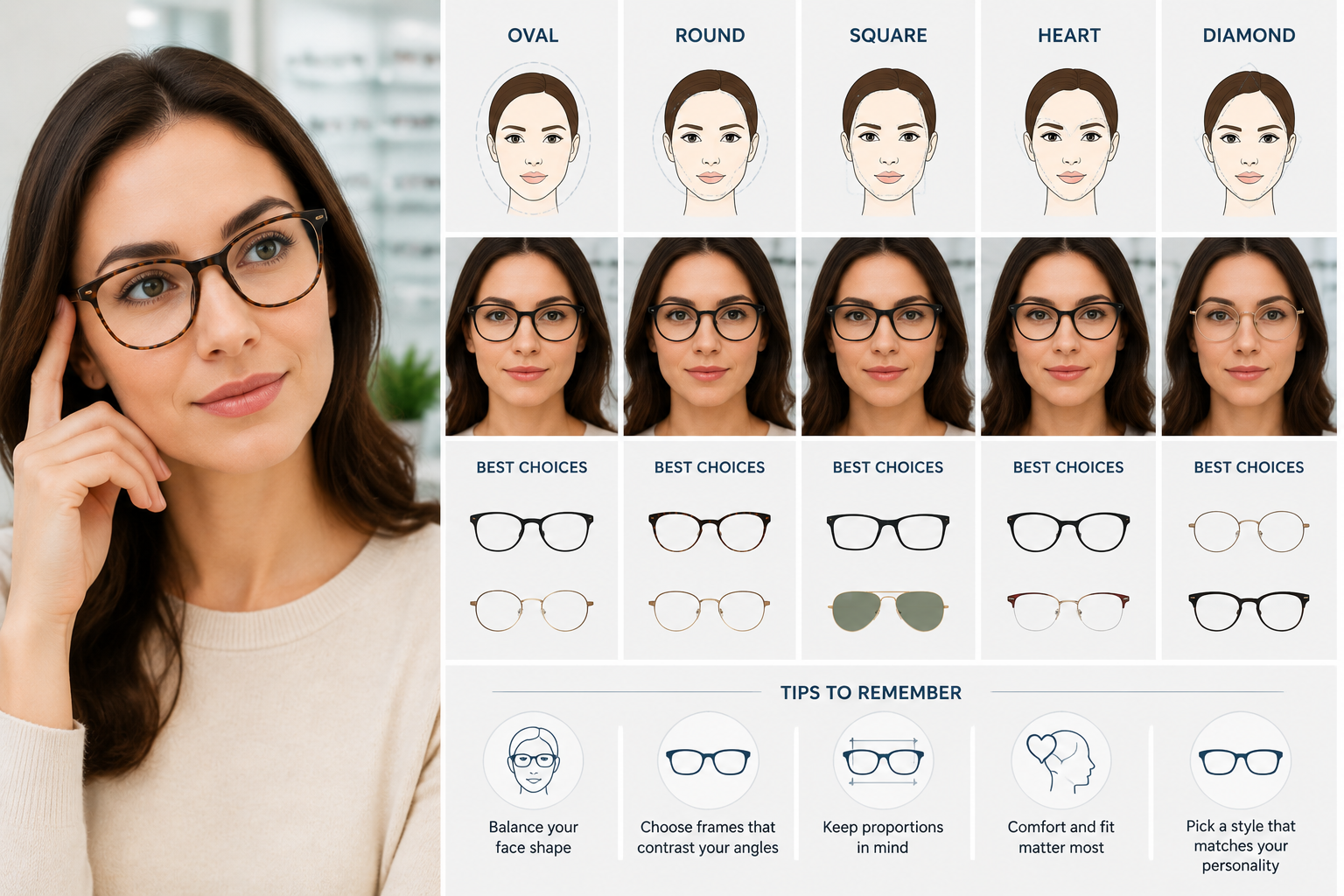
Let’s be honest, buying glasses can feel oddly stressful. You walk into an optical store, try on seventeen pairs, and somehow none of them feels quite right. Some look too big. Some feel too harsh. A few seem fine in the mirror, but something’s just… off.
Here’s the thing most people don’t realise: it’s not about finding frames you like in theory. It’s about finding frames that actually work with your face. And once you understand your face shape, that whole process becomes a lot less overwhelming and a lot more fun.
Here, we break it all down practically and without making you feel like you need a degree in geometry.
First Things First: How to Figure Out Your Face Shape
Before you pick frames, you need to know what you’re working with. Grab a mirror and a soft measuring tape (or even just observe — you don’t need to be exact). You’re looking at four key areas: your forehead width, cheekbone width, jawline width, and face length.
Once you have a rough sense of those proportions, you can match yourself to one of the six main face shapes below. Don’t stress if you’re between two shapes — most people are. Just go with whichever description feels closest.
Square Face — Soften What You’ve Got
A square face has a strong jawline, a broad forehead, and cheekbones that sit at roughly the same width as both. Everything is angular, structured, and proportionate. Think well-defined not in a bad way, just in a way that needs the right frame to balance it out.
The goal with a square face is to soften those sharp angles. Hard lines meeting more hard lines doesn’t do you any favours.
What works: Round and oval frames are your best friends. Their curved lines create a natural contrast to your jaw and forehead, making your whole face look more balanced. Cat-eye frames can also work beautifully — they add a bit of upward sweep without emphasising the width. Semi-rimless styles are worth exploring too, as they feel lighter and less geometric against your features.
A few things to keep in mind:
- Frames that sit slightly higher on your nose bridge will help elongate your face, which is a good thing for square shapes.
- Avoid very boxy or heavily rectangular frames they’ll just mirror your natural angles rather than balance them.
- Don’t go too oversized. A frame that overwhelms your face will make it look wider, not better.
Heart Face — Balance Is Everything
A heart-shaped face is wider at the forehead and gradually narrows down to a more pointed chin — like an inverted triangle. High cheekbones usually come with the territory. It’s a striking shape, but it means the top half of your face naturally draws more visual weight than the bottom.
Your frame goal: shift some of that visual balance downward.
What works: Frames that are wider at the bottom, like classic aviators are ideal because they add visual width near the chin and soften the forehead. Rimless and light-coloured frames are a great option if you want something understated that doesn’t compete with your features. Oval frames are flattering too, adding gentle curves that draw attention to your eyes without emphasising the width of your forehead.
Also read: Everything You Need to Know Before Booking an Eye Exam
A few things to keep in mind:
- If you’re self-conscious about your forehead, try frames with low-set temples (the arms that go over your ears). This naturally draws the eye downward.
- If your chin is very narrow, lean into bottom-heavy frames to create the illusion of more width at the lower face.
- Avoid frames that are heavily decorated or wide at the top; they’ll only add more emphasis to an area that doesn’t need it.
Oval Face — Lucky You
An oval face is generally considered the most versatile face shape for eyewear and for good reason. It has naturally balanced proportions, a gently curved jawline, a forehead that’s slightly wider than the chin, and high cheekbones. Basically, it plays well with almost everything.
That said, “almost anything works” doesn’t mean anything goes. There are still smarter choices.
What works: Rectangular, square, and geometric frames all look great on oval faces because they add a bit of structure to the soft, rounded proportions. Wider frames — ones that are at least as wide as the broadest part of your face — maintain the natural harmony rather than disrupting it.
A few things to keep in mind:
- Avoid frames that are overly large or overly small. Both extremes will throw off the natural balance that makes an oval face so easy to dress.
- If you want to highlight your cheekbones, a slightly upswept or cat-eye style does that nicely.
- One of the biggest advantages of having an oval face shape is its versatility. Classic frame styles like wayfarers, browlines, and rectangles all tend to complement your balanced features, creating a polished and timeless look.
Triangle (Pear) Face — Draw the Eye Upward
A triangle or pear-shaped face is the opposite of a heart — it’s narrower at the forehead and gets wider toward the jawline and chin. This shape is less commonly discussed, but it’s more common than people think.
The goal here is to draw attention upward, to the upper half of your face, so your features feel more proportionate overall.
What works: Cat-eye frames are excellent here — the upswept design naturally pulls the eye toward your forehead and temples, which is exactly what you want. Browline styles work for the same reason. Look for frames that have bolder detailing or more visual weight at the top. Bright colours or interesting textures at the upper frame can also help achieve this effect.
A few things to keep in mind:
- Avoid frames that are bottom-heavy or wide at the base. They’ll add more visual width to an area of your face that’s already the widest.
- If you have what’s more of an inverted triangle — wider forehead, narrower chin — flip the advice: go for frames that are slightly bottom-heavy to bring balance.
- Light, rimless styles are a quiet option if you’d rather let your features speak for themselves.
Diamond Face — Play Up Your Cheekbones
A diamond face shape is defined by prominent, high cheekbones, with a narrower forehead and chin. Its naturally angular and well-defined features create a striking appearance, and the right pair of glasses can beautifully enhance that unique facial structure while adding balance and style.
The goal is to soften those angles slightly and draw attention toward the eyes, which sit right in the middle of all that structure.
What works: Cat-eye frames are a natural fit — their shape mirrors and accentuates the cheekbones in a way that feels deliberate and stylish. Oval frames also work well, adding softness without competing with your bone structure. Rimless or semi-rimless frames are a solid choice when you want something that highlights your features without adding visual bulk.
A few things to keep in mind:
- Avoid very narrow or small frames – they’ll get lost against the width of your cheekbones.
- This is one of the best face shapes to experiment with bold, expressive frames. A dramatic cat-eye or an interesting geometric shape can look genuinely striking.
- Frames with detailed brow lines — those that have a distinctive upper edge — work especially well here because they focus attention on the eyes.
Round Face — Add Structure and Definition
A round face has soft, curved lines throughout — the width and length are roughly equal, cheeks are full, and there aren’t many sharp angles to speak of. It’s a warm, approachable shape, but the challenge with eyewear is that you want to avoid frames that make the face look even rounder.
The goal is to add angles, definition, and a bit of elongation.
What works: Rectangular and square frames are the go-to choice because their sharp lines contrast beautifully with a round face’s softness, creating structure and making the face appear longer and slimmer. Geometric frames work for the same reason. Cat-eye styles are another great option — their upward sweep lifts the face and draws attention to the upper features rather than the width of the cheeks.
A few things to keep in mind:
- A clear or thin nose bridge can help make the eyes look wider and add the illusion of length.
- Avoid perfectly round frames — they’ll mirror your face shape rather than balance it, which is the opposite of what you want.
- Avoid very wide frames that extend far beyond the sides of your face — they’ll add horizontal width when you actually want more vertical definition.
A Few Universal Rules Worth Remembering
Regardless of your face shape, these guidelines apply across the board:
Your frames should not extend wider than the widest part of your face. The top of the frame should sit somewhere near your eyebrow line — not above it, not far below it. The frame shouldn’t press against your cheeks when you smile or slide down your nose when you look down. Comfort is non-negotiable.
And the most important rule of all? These are guidelines, not laws. Face shapes exist on a spectrum. Personal style matters. If you try on a pair of frames that technically “shouldn’t” work for your shape but you feel great in them — that counts for a lot. Confidence is always the best accessory.
Final Words
Choosing the right glasses doesn’t have to feel like solving a puzzle. Once you know your face shape you have a clear starting point. From there, it’s about finding the frames that contrast and complement your natural proportions, rather than fighting against them.
Quick Reference Guide
|
Face Shape |
Best Frames |
Avoid |
|
Square |
Round, oval, cat-eye |
Heavy rectangles |
|
Heart |
Aviators, rimless, oval |
Wide or top-heavy frames |
|
Oval |
Almost anything — rectangular, geometric |
Oversized or very tiny frames |
|
Triangle |
Cat-eye, browline, bold tops |
Bottom-heavy frames |
|
Diamond |
Cat-eye, oval, rimless |
Very narrow or small frames |
|
Round |
Rectangular, square, geometric, cat-eye |
Round frames, very wide frames |
Ready to Find Frames That Actually Suit You?
Visit Smart Opticals and let our team help you choose eyeglasses that match your face shape, style, and comfort perfectly. Book your eye exam or shop today to explore our latest collection.